Anyone who doesn’t think of themselves as imaginative has only to look at the content of their minds when they worry. A big component of worrying is visualizing bad outcomes, from minor elements out of order to large-scale disaster. Worst-case scenarios are part of planning, whether intentional or of the self-doubt variety. On the positive end we daydream, and try out pleasant situations and invent new relationships. Clearly both are creativity at work. This capacity to project ourselves into the future and invent scenarios that develop the events that are currently unfolding is a triumph of evolution. A person who worries about the worst that can happen doesn’t think of it as creative, but the combination of future awareness and multiple possibilities is pure imagination. A certain amount of worry is an important aspect of planning. We need to visualize complex tasks and prepare for what’s needed. When we worry too much, we’re using our highest human powers to torment ourselves. I’ve read that excessive worrying is connected to superstition, reflecting an underlying belief that to think obsessively about a situation in advance can somehow deflect the adverse outcome. Though superstition is considered a thoughtform left behind in the course of mental evolution, its patterns persist under new names. We express our fears in mental images. My sister-in-law said she envisioned the worst so that whatever happened if it wasn’t the worst would seem good, and if it was then she’d be prepared. This is just one way we are always tempering, treating and modifying our emotions with images in our mind. Many modes of therapy have been developed that utilize this capacity, focusing on producing positive and healing images. What we see in our mind’s eye can have as powerful affect on the body as actual experience.
Imaging information aids intellectual understanding as well. I recently heard a woman on the radio who made her living fishing in the Gulf of Mexico call into a show about testing fish for oil contamination. She asked if they would publish where they’ve tested on maps, putting it “in layman’s terms”. Looking at a map one can see in an instant which areas have been declared safe. The endless stream of numbers that had been published so far did not make the overall situation clear. Since knowledge is mapped by location in our minds, seeing is understanding. I’ve heard visual thinking referred to as common sense. It’s the day-to-day life intermingling of the images in our head with the images in our surroundings. Plotting a new route to work when the regular road is blocked, sensing when an argument between friends is about to get out of hand and shifting their attention to other things. We can retrace our steps to find something we’ve lost because we have the space of our lives envisioned within us. Our ability to hold many relationships in our mind at once depends on locating them together in images.
We aren’t able to evolve this powerful capacity because, not happening in words, it goes unnoticed. A student said to me with assurance, “All conscious thought is in words.” But these mental images are conscious and affecting. We understand the meaning a situation has for us through the images we produce in relation to it.
The dominance of verbal language is diminishing as our connection to the cyber realm of information becomes more visual. Linear menus shift to sitemaps because a sitemap shows the relationship between the options – and seeing is faster than linear processing. Looking at art should be part of visual literacy. Since so much of the instant assessment we make with our eyes has to do with the feeling of things – what’s harmonic or off-kilter- attention to art will sensitize us to deeper levels and larger archetypes than we get from commercial media. Every one of us has a powerful imagination we’re using all the time. Cultivating it is a crucial part of developing minds that can cope with the future.
Saturday, August 14, 2010


Thursday, July 29, 2010

Sixty Today
A commercial I saw yesterday had a guy saying “I know sixty is the new forty” then going on about how young he felt inside. What bothers me about this is the clear underlying assumption that younger is better. I found myself thinking back to a conversation with friends when I was a young adult where we speculated about the age we felt we were inside. Most were saying younger or a little older, but I found myself saying sixty. Maybe I’d always felt older inside but there was also the feeling that it would take me a long time to do what I wanted to do (not that I had any idea of what that was). I’d read that philosophers didn’t come of age until their sixties, so that seeded the belief that some aspirations took longer than others. My grandfather was my favorite person throughout my youth, and age seemed to be a part of the radiant equanimity I admired so much in him. Gaining in years led to the achievement of a state of mind and approach to living that couldn’t be rushed.
The claim to feeling young is a tacit agreement that young is better. I feel energetic, excited about life and more full of love than I ever was when young. Not only was young not better, young was being lost in the woods. It puts unfair pressure on young people who are supposed to be having the “best years of their lives” before they “waste their youth”. In such a complicated world, we might expect that the necessary skills for living would take time to acquire.
Our culture creates fear of age with terminology of loss as a marketing tool. When people are convinced that aging means losing something, their attention is focused on what will give it back. It’s a strategy that debilitates people’s attention to the actuality of their present life and the new experiences and meaning of the moment. Running after youth is a form of regression, not growth. The cultural view of aging focuses on what’s lost, as though the natural fading of some faculties is something to be fought rather than something that can be learned from and understood in an entirely new way. To me the losses are minor compared to the gains. I look at aging as a process of accumulation. Everything we’ve been is still there and available to us as past experience. Like the rings on a tree record the history of the tree, and the tree grows wider and stronger and taller, our memories and accumulated knowledge make us stronger, enable us to rise, to gain perspective through our increased experience. This helps me feels more comfortable and at ease in the world. I’ve increased my “clearing is the forest” in the words of Joseph Chilton Pierce and understand myself more as active patterns in the world than as material being.
So today I come of age. Maybe I’m a real late bloomer, but it’s taken me this long to begin to synthesize what I’ve learned into some coherent ideas, and twenty years of meditation to calm the tangle of anxiety that characterized my youth. I’m excited about the possibilities I’ve prepared for myself and rejoice to see my grandfather’s attitude toward life coming into reach. I’m happier and more engaged than I’ve ever been. What could be better than to be here now?
Saturday, July 17, 2010

Current Choices
The action of selection is what we call “free will”. Riding multiple currents beyond our control, we are constantly making choices that determine the nature of the ride. Choices about direction are as simple and automatic as where we look in any given situation, what gets our attention. Once engaged we choose among the potentials of that situation as it unfolds. This is where self-awareness comes in handy and increases the available choices. If you’ve been paying attention to your patterns of reaction and the situations that result, you can choose a path that is not the automatic one of the past.
The new mammalian layer of the brain flows into the neocortex, so named because it’s the newest. It is where the perception of the future begins, and with perception of the future comes anxiety. There are two ways we handle anxiety. One is retreat into older layers of the psyche that deal with fear. This means withdrawing or defending. The other is to do something—anything- to move forward. As Alfred Adler said, the important thing is to get moving. That’s why exercise alone will improve general mood and mental function. But a bigger group of connections to the pleasure center is from our most human powers, the prefrontal cortex in the front of the brain. Evolution has built in an appetite for challenge and novelty, more reward response as we move the mental energy toward to front of the brain. We’re meant to use and develop our capacities, whatever they are, to grow as individuals. It’s the growing that feels good, extending our abilities, without thinking of the outcomes or results. Envisioning the future shapes the goals, but getting too attached to the outcome disconnects us from the process- being present to what’s happening at the time. And the current of time includes plenty that we can’t envision in advance so attention to the actual is a very important first choice.
Many fields of action influence our position in the current. The circumstances of work, family, friends, are each unfolding in a location alive with patterns. Our connections through computer networks, the moods and health of our mind and body all are factors in the place we find ourselves and from which we navigate via the selections we make about where we’re going. We adapt to the changes in the current or it wears us down. When conditions are bad the only choice we may have is the attitude we can take, but we can keep the energy in the evolved intelligence, the front of the brain if we’re looking for what’s to be learned and how we can use that knowledge. When Viktor Frankl was working at forced labor in horrible conditions, he envisioned himself standing in front of an audience giving a speech about how he survived. Imagination into a future that makes use of the current lesson created a brain chemistry that stimulated his ability to survive.
Increasing our freedom in the realm of ideas depends on having more possibilities from which to select and construct our own. The battle of right and wrong ideas is about who has the power to impose their ideas on others, the power to limit the scope of ideas.
Every time you hear someone cut off a topic of conversation as beyond discussion they are trying to assert power over what we’re allowed to think, but it is only through discussion and the hybrid thoughts that grow there that we can gain perspective and break free of the limitations of rigid, right/wrong categories and the anxiety that comes with them.
Helpful ideas spread from all parts of the globe. I’ve been enriched by Tai Chi and Lao Tzu, yoga and my neti pot, France (the country), and philosophers and thinkers from everywhere. The range of perspectives allows me to see more patterns and create a personal view that depends on having that many choices. If we drop the stultifying barriers inherent in fixed ideologies and allow the full range of the human mind to influence us, how could we not evolve as a species.
Wednesday, June 30, 2010
Organic Intelligence
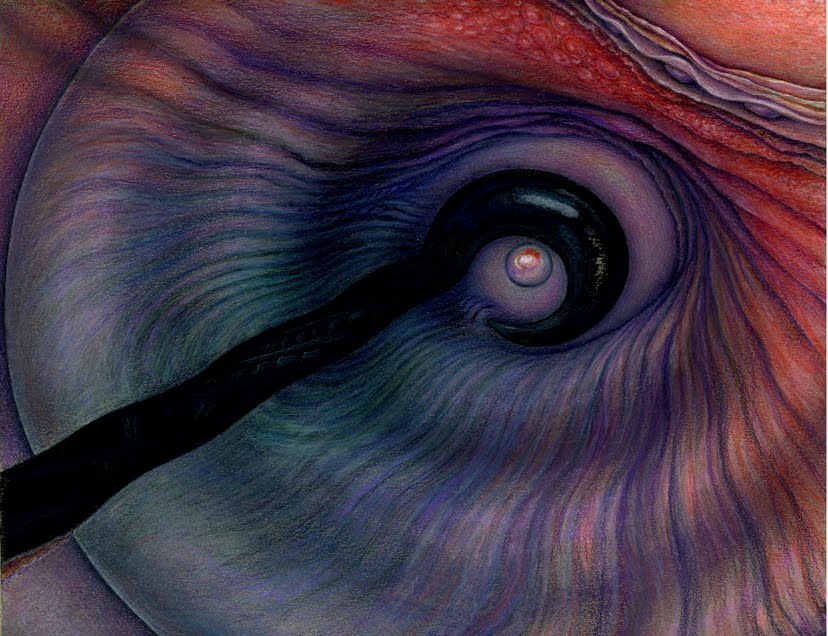
Since the sixties, thinkers have been suggesting it’s time to shift our model of reality from the giant machine to the image of the universe as an organism. Fritjof Capra talks about the shift in worldview that came with quantum mechanics in his wonderful book “The Turning Point”. He writes, “The universe is no longer seen as a machine made up of multiple objects, but has to be pictured as one indivisible, dynamic whole whose parts are essentially interrelated and can be understood only as patterns of a cosmic process.” Seeing the whole is essential to understanding the significance in a situation and is the essence of ecological consciousness. We understand the big picture through concrete vision as well as within our spatial embodied imagination.
The heartbreaking pictures of the oil gushing into the Gulf of Mexico can be seen as our body bleeding. The globe that supports us all is pierced and hemorrhaging. All the images taken from space that show the growing damage hurt my heart like damage to my own body. Which it is, given I am absolutely dependent on it. A caller to the Diane Rehm show was the first to express out loud the fear this oil spill could kill the whole planet. The satellite and helicopter pictures are the diagnostic scans of our global body. The compartmentalized, rapacious way of looking at the planet that grows from the machine model avoids seeing the interconnections. It may suit the corporati and greed-driven, but an attitude of seeing the planet as a giant reservoir of resources to be exploited interferes with the balance of the all-inclusive organism. Chief Seattle said, “The earth does not belong to us, we belong to the earth.“ Stabbing oneself in the hope of riches expresses reckless self-loathing.
Organic intelligence is alert to the health of the whole. Since everything is part of an intricate network of interrelated systems, we’re happiest (best brain chemistry) when we’re developing our abilities and finding challenging ways to make use of them. This adds our health to the health of the larger organism in which we participate. Moving in harmony with the flow of being around us is natural if the underlying model of the universe has ourselves as part of an organic whole. If we’re disrupting other aspects of the larger being we’re like a cancer, growing without heed of the damage we cause, sucking up vital resources without regard to the host. Much of what divides us and keeps us from acting together is imagery that places us outside of things, casting us as the one that tinkers with the machine. This is the same image as the large scale Maker, which also puts the traditional God outside us.
The Gaia Hypothesis came out decades ago. James Lovelock’s conception was of a consciousness within the earth itself. Just like the adjustments made in our own body, it responds to imbalances. This universal motion of homeostasis exists on every level and in every system, adapting to change to restore equilibrium. Persisting in the belief in man’s dominion over the earth may lead to the earth itself wiping out the source of destruction.
The materialistic world of separate things has resisted seeing our interconnectedness because it’s a threat to a competitive attitude. Accumulating and controlling more of the planet does not serve the good of the whole. But there’s evidence mounting of the grassroots shift to a more responsible way of seeing. Two website groups that have contacted me recently are dedicated to positive change. The Superforest site
( http://teamsuperforest.org/superforest/ ) sees the essence of problems and solutions in the world as revolving around manners. Treating everyone and everything with respect means being aware of the consequences of our actions. As they say in their Humanifesto, dumping pollutants in a river is bad manners. The narrow sight lines of a competitive stance focus on the end result and miss much of what’s happening now and the consequences of single-mindedness. A cooperative attitude is tuned to the moment because cooperation is all about adjusting to the circumstances and harmonizing with others. The current most popular entry at The Truth Contest site
( The Truth Contest ) focuses on the Present and the nature of consciousness. Their site is committed to an ongoing attempt to articulate truth, to search out the universals that bind us. They turn the idea of a contest on its head since there’s no competition, no prizes, just an on-going dialogue that features the entries that generate the most interest. Extending themselves for the good of the whole, these sites are examples of healing forces, the action of Gaia’s immune system. They give me faith in the goodness of human nature and optimism about the future. I’m happy to now be connected to both efforts.
Subscribe to:
Posts (Atom)