Recently NPR reported a new study that looked at babies’ preferences for different artists. Given the choice of Leonardo da Vinci, Andy Warhol, and Picasso, they consistently preferred Picasso. When it comes to taking interest in the outside world, nothing is more important to babies than facial expression. A balloon with a smiley face will hold their attention until the face is turned away. Other recent research showed that caricatures that emphasize certain features elicit a stronger response than the face itself. The exaggerated expressions in Picasso would obviously be most appealing. The information given by a face is the most important early information we learn because it enables us to see how others are feeling. Mirror neurons fire in simulation of the expression inside so we feel the state we see. A contempt face on another person will make our heart race whether acknowledged or not. It may be that the appeal of symmetry in the human face has more to do with the expression than the features. We’re all pretty symmetrical in the arrangement of our features when we’re relaxed or happy, content and focused. Negative emotions tend to twist the face out of shape, the sneer that raises one side of the mouth, disgust that pulls one side down. Faces that are critical, skeptical, angry or sad each twist the natural symmetry of our features. Thich Nhat Hnan wrote, “Whenever anger comes up, take out a mirror and look at yourself. When you are angry you are not very beautiful…Hundreds of muscles in your face look very tense”. He advises us to breathe and smile mindfully to return to natural beauty. Often when I talk with a class about this, pointing out that negative emotions are what make people unattractive because the tension in those muscles pulls the face out of symmetry, someone knows a person with the features to be beautiful, but isn’t, because the person was mean or paranoid or some other unpleasant characteristic that pinched up the face. Pain also distorts our symmetry. I was intrigued to read in a “Scientific American-Mind” magazine that early pleasure in symmetry connected to health. What is too much off symmetry and out of balance is associated with disease.
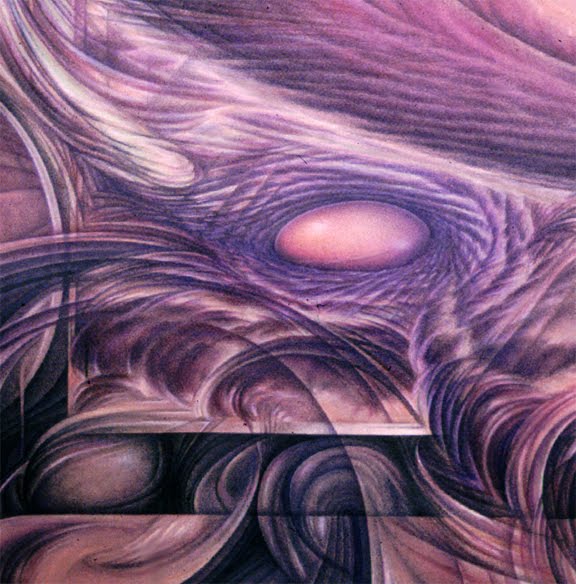
The approach to symmetry underlying my recent work begins with the intersection of wave fronts that create interference patterns. Thinking about vibrations and formative influences as much as I have over many years I’ve come to think of matter as a very condensed and complex interference pattern. A picture of a swimming pool during the earthquake showed waves that form at the sides meeting in the middle and becoming an interference pattern of standing waves where they appeared to hold still, frozen until the energy pattern that stimulated it changed. Like the eye of Jupiter maintains its shape even though it’s a clot of churning gases, so we humans could be a constant flow of energy not as solid as we think, a density in the continuous field of energy that includes everything.
We humans and most organic life are slightly off symmetry, but balanced around an axis that holds its shape until the supporting systems break down. If something is too ordered it stops moving. Excess in any area will throw off the balance. Playing with that tension is a way of exploring what may be a primary principle of visual philosophy. The symmetry in our bodies is a model for the mirroring of external expression. Accurate internal mirroring of what we see is the essence of understanding and foundation of communication.
Thursday, September 29, 2011


Friday, September 9, 2011

Spatial Intelligence
Oliver Sacks in Musicophilia discussed a syndrome some are born with where even with fully developed frontal and temporal lobes, considered primary to intelligence, and often with extensive vocabularies or outstanding musical skills, were unable to take care of themselves, to perform simple actions like tying shoes. The undeveloped part of the brain was the parietal lobe, home of our understanding of ourselves in space, our sense of where we are, our position and direction in our surroundings. Parietal intelligence is the intelligence of Einstein. (That was the part of his brain that was discovered to be bigger than other people’s.) He said his ideas came to him as images and indeed, much of our own use of language depends on metaphors based on moving in space. I think of parietal intelligence as “deer consciousness”; precisely aware of distance and speed, the vectors of movement, that when abstracted and symbolized at the human level become higher mathematics. At the visual level, a broad awareness is attuned to every shift and change in the surroundings. Assessments of ongoing change are the business of daily life.
Spatial intelligence reaches its pinnacle in tennis. The level of focus combined with alert awareness, heighten by anticipation, application of everything observed and known, into spontaneous response crafted by years of dedicated effort is a heartening thing to witness.
Listening to the TV commentators I started to realize how much of the language they were using was also the language you might hear from a coach in the practice of Zen. They talk about the virtues of taking it one point at a time, use phrases like “Staying in the Moment” that illustrate the present-centeredness true of a genuine spiritual state. And it’s easy to see how the mental chatter in the mind of any player is what defeats them and not usually a failing of the body. Throughout the game the unreturnable shot is called a “winner”. Winning is not something reserved for the result but happens throughout the game. Perfect placement and execution is a triumph in every instance it’s achieved. Attention to the moment, acting at the height of personal capability is the state of involvement we call flow. In the language of sports, to be in the Zone is to be continuous with the game, purified of the self-doubt and inner narration that keep us from doing what we can.
Watching Donald Young, a player I’d never seen before, I had so many opportunities to say “Wow!” and “Yesssss!” I was feeling really good, what with all the dopamine and endorphins flowing; when another outstanding shot was hit it left me laughing with pleasure. Our mirror neurons, following high quality action, stimulate the same brain chemistry ( to a lesser extent but still, we’re sitting on the couch). David Foster Wallace put it this way in one of his essays on tennis. “Great athletes are profoundly in motion. They enable abstractions like power and grace and control to become not only incarnate, but televisable.” I can’t help thinking about Roger Federer when Wallace writes, “There is, about world-class athletes carving out exemptions from physical laws a transcendent beauty that makes manifest God in man.”
The embodiment of ideals and the privilege of being able to watch their peak moments is an elevating experience. I don’t think Wallace overstates it. Incarnation is manifest spirit. There can be no charlatans. You can’t get there unless your dedication is genuine. All the training and hard work, perseverance and focus culminate in the championship moments that we get to share. Human beings need these models of human possibility to remind us of the power of attention to whatever our being in space is doing. It is this full attention that makes an activity autotelic, a pleasure in the doing itself. Pursuing excellence in anything feels good because we’re increasing our power, focusing on the action in the world through our embodied being. Emulating what we admire is how we become what we want to be. The qualities that make a great tennis player demonstrate virtues useful to any attainment.
Spatial intelligence reaches its pinnacle in tennis. The level of focus combined with alert awareness, heighten by anticipation, application of everything observed and known, into spontaneous response crafted by years of dedicated effort is a heartening thing to witness.
Listening to the TV commentators I started to realize how much of the language they were using was also the language you might hear from a coach in the practice of Zen. They talk about the virtues of taking it one point at a time, use phrases like “Staying in the Moment” that illustrate the present-centeredness true of a genuine spiritual state. And it’s easy to see how the mental chatter in the mind of any player is what defeats them and not usually a failing of the body. Throughout the game the unreturnable shot is called a “winner”. Winning is not something reserved for the result but happens throughout the game. Perfect placement and execution is a triumph in every instance it’s achieved. Attention to the moment, acting at the height of personal capability is the state of involvement we call flow. In the language of sports, to be in the Zone is to be continuous with the game, purified of the self-doubt and inner narration that keep us from doing what we can.
Watching Donald Young, a player I’d never seen before, I had so many opportunities to say “Wow!” and “Yesssss!” I was feeling really good, what with all the dopamine and endorphins flowing; when another outstanding shot was hit it left me laughing with pleasure. Our mirror neurons, following high quality action, stimulate the same brain chemistry ( to a lesser extent but still, we’re sitting on the couch). David Foster Wallace put it this way in one of his essays on tennis. “Great athletes are profoundly in motion. They enable abstractions like power and grace and control to become not only incarnate, but televisable.” I can’t help thinking about Roger Federer when Wallace writes, “There is, about world-class athletes carving out exemptions from physical laws a transcendent beauty that makes manifest God in man.”
The embodiment of ideals and the privilege of being able to watch their peak moments is an elevating experience. I don’t think Wallace overstates it. Incarnation is manifest spirit. There can be no charlatans. You can’t get there unless your dedication is genuine. All the training and hard work, perseverance and focus culminate in the championship moments that we get to share. Human beings need these models of human possibility to remind us of the power of attention to whatever our being in space is doing. It is this full attention that makes an activity autotelic, a pleasure in the doing itself. Pursuing excellence in anything feels good because we’re increasing our power, focusing on the action in the world through our embodied being. Emulating what we admire is how we become what we want to be. The qualities that make a great tennis player demonstrate virtues useful to any attainment.
Tuesday, August 30, 2011
Picture Power
The old adage “One picture is worth a thousand words,” understates the case. There are so many levels of information conveyed by an image that the linear trickle of words can’t begin to approach. Not just the facts of what’s there, but the relations between them, the state of balance that leads us to expect motion or stillness, the feeling tone our processing of the image creates within us. We are always in a picture complete with weather and the psychology of other people; a complexity that no theory created with labels can touch. Looking at the videogame “Halo” with my nephew, I felt I was seeing the future that young people fear, the dramatic scenery of a long gone technological civilization that left behind demons for the survivors. The training of visual responsiveness offered by games and the “look and choose” nature of the Internet are leading us away from verbal dominance. Just in time. Power uses labels to create enmity, divisions that can be exploited and strengthened by repetition and careful choices of inflammatory pictures. The big world of cyber connectivity, and interactive challenge, could neutralize old word-based power because future generations will simply stop paying attention. The practical ways that images contribute to understanding is leading the growth of infographics with sites like EnvisionFinancials.com showing budgets and financial relationships as a 3D nested pie chart. I expect a cascade of innovative applications coming as the visual thinkers raised on sophisticated video games come of age.
Recently, I participated in an “English as Second Language” class at MICA. The discussion of self-portraits they had done clearly showed how much meaning was communicated by each image. They suggested stories, worlds changing, the passage from childhood to this transitional state of independence, attitudes, feelings, so much that is truly beyond the power of words to show so specifically. They may not have felt confident with the language, but because they were being asked to say what the picture did for them individually, it offered the opportunity to use the language creatively and find words that could reflect their own take on each image. With a range of different life experiences there was a rich variety of associations to each, and different sensibilities picked up on different qualities. The structure of the image resonates with similar structures within each of us and we were free to use the words that best show where the image took us. Jung’s statement “Image is psyche,” emphasized the correspondence between archetypes and visual structure. We can see stability or upheaval, dominance or submission. Images convey the depth of us. When we talk about them we discover how the differences in the specifics of our lives connect in the pattern beneath the surface. This particular discussion was a clear illustration of how the communication that happens in pictures transcends words and connects people around the shared understanding of it. When someone made an observation the rest of us hadn’t seen, the reaction was usually pleasure. We saw it once it was pointed out and the comment enlarged our understanding. Offering the aspects of a picture that we respond to enlarges the perspective for everyone. It’s this unifying aspect to visual communication that is most needed now and in the future. People are unnecessarily divided by labels. Our natural state is embedded in our environment and the flow of events around us.
Recently, I participated in an “English as Second Language” class at MICA. The discussion of self-portraits they had done clearly showed how much meaning was communicated by each image. They suggested stories, worlds changing, the passage from childhood to this transitional state of independence, attitudes, feelings, so much that is truly beyond the power of words to show so specifically. They may not have felt confident with the language, but because they were being asked to say what the picture did for them individually, it offered the opportunity to use the language creatively and find words that could reflect their own take on each image. With a range of different life experiences there was a rich variety of associations to each, and different sensibilities picked up on different qualities. The structure of the image resonates with similar structures within each of us and we were free to use the words that best show where the image took us. Jung’s statement “Image is psyche,” emphasized the correspondence between archetypes and visual structure. We can see stability or upheaval, dominance or submission. Images convey the depth of us. When we talk about them we discover how the differences in the specifics of our lives connect in the pattern beneath the surface. This particular discussion was a clear illustration of how the communication that happens in pictures transcends words and connects people around the shared understanding of it. When someone made an observation the rest of us hadn’t seen, the reaction was usually pleasure. We saw it once it was pointed out and the comment enlarged our understanding. Offering the aspects of a picture that we respond to enlarges the perspective for everyone. It’s this unifying aspect to visual communication that is most needed now and in the future. People are unnecessarily divided by labels. Our natural state is embedded in our environment and the flow of events around us.
Thursday, August 18, 2011

Ongoing Change
“The Book of Changes” was the translated title of the ancient Chinese book “I Ching” that first attracted me. In my twenties at the time, it seemed like the scale of uncontrollable factors in the churning world around me overwhelmed the strategies for living surrounding me in the culture. Taoism and I clicked instantly around the foundation understanding that movement and change and adapting to shifting circumstances while in motion myself was the only useful image for balance. Being aware of patterns of movement is far more helpful than the names and definitions of things. Labeling and weighing numbers of things, though useful in certain spheres of life, can’t be an image of life itself. Every category and box one is sorted into comes with an attached judgment that, if one is dependent on thinking with labels, takes the place of the actual, in-front-of-your face reality. Naming something is a way of controlling it and creates an illusion of knowing that can be highly destructive to making real contact with the world. One of the benefits of video games is the degree to which it uses sophisticated instinctual visual assessment and banishes verbal thought. And because it depends upon complete attention, all the time, it can be an exhilarating involvement we have lost the art of in the real world. Because we’ve substituted labels and judgments and the spill of theories that grow from them we’ve built walls of ideation that limit our capacity to pay attention to the movements of life. When walking becomes fitness, a treadmill and set of numbers, we miss the relation to outdoors, the fact that every day is different, that we are always responding to the wind and temperatures, a bird or squirrel. The automatic part is there, but the narration of life in our head, the piles of verbal thought all around us keep us from seeing the life in which our body participates. Make a game of the walk, note how many changes you see in the same neighborhood every day. Our bodies are always doing this. We just aren’t paying attention. Our response to the world is a dance, a natural adjustment to the movement around us that makes us part of it. Paying attention is the key to enjoying it.
A book that gives advice about how to handle the different states of change is better than a list of unchanging rules. It helps us see the overall dynamic in which we’re embedded and see realistically what can be done in such a state. Handling the situation well always emphasized cultivating character and virtue. Today’s research shows that the reason it feels so good is because we stimulate endorphins when we are virtuous. It’s good for our survival because it harmonizes us as a collaborator with the moving world.
Looking back on my recent posts I realize to what degree the philosophy in the “I Ching” pervades my thinking. Seeing the world as a dynamic whole, it uses the imagery of nature to express the cosmic intelligence that underlies all phenomena.
A mechanical view of the world leaves out contextual pattern. We don’t learn that much more about life by stripping away all the variables that make it life. A world of multiple variables needs a philosophy based on adjustment, metaphysical homeostasis based in the understanding that the metaphors of striving for balance can apply to any living system. In the midst of so many uncontrollable changes it makes sense to “not be led by hopes and fears”. Like the yang-yin symbol, each contains a bit of the other. Our ideas about them are what make us suffer.
More than thirty years of regular reading in the “I Ching” has created an underlying approach to life that invigorates each moment of being. Names and labels reduce the richness of continuous being to desired points along the way, where we can only enjoy results and not the pleasure of doing. Erich Fromm wrote about the many ways that an attitude toward life based on having- possessions, accomplishments, problems, a body, a life, a goal, was less satisfying than an attitude based on being- living, doing, feeling- participating in an unfolding process. We are what we do. We do it better when we’re paying attention.
A book that gives advice about how to handle the different states of change is better than a list of unchanging rules. It helps us see the overall dynamic in which we’re embedded and see realistically what can be done in such a state. Handling the situation well always emphasized cultivating character and virtue. Today’s research shows that the reason it feels so good is because we stimulate endorphins when we are virtuous. It’s good for our survival because it harmonizes us as a collaborator with the moving world.
Looking back on my recent posts I realize to what degree the philosophy in the “I Ching” pervades my thinking. Seeing the world as a dynamic whole, it uses the imagery of nature to express the cosmic intelligence that underlies all phenomena.
A mechanical view of the world leaves out contextual pattern. We don’t learn that much more about life by stripping away all the variables that make it life. A world of multiple variables needs a philosophy based on adjustment, metaphysical homeostasis based in the understanding that the metaphors of striving for balance can apply to any living system. In the midst of so many uncontrollable changes it makes sense to “not be led by hopes and fears”. Like the yang-yin symbol, each contains a bit of the other. Our ideas about them are what make us suffer.
More than thirty years of regular reading in the “I Ching” has created an underlying approach to life that invigorates each moment of being. Names and labels reduce the richness of continuous being to desired points along the way, where we can only enjoy results and not the pleasure of doing. Erich Fromm wrote about the many ways that an attitude toward life based on having- possessions, accomplishments, problems, a body, a life, a goal, was less satisfying than an attitude based on being- living, doing, feeling- participating in an unfolding process. We are what we do. We do it better when we’re paying attention.
Subscribe to:
Comments (Atom)