Tuesday, June 18, 2013

The Mindfulness Game

Since various nervous habits have been edging up throughout the school
year I vowed to play what I’ve come to think of as “The Mindfulness
Game” again this summer. As I wrote about in ”Making A Game of
Self-Improvement”
(http://seeingmeaning.blogspot.com/2011/06/making-game-of-self-improvement.html
), this had been the most effective technique I’d ever tried,
successfully eliminating them by the end of the summer. Just as Jane
McGonigal wrote in “Reality is Broken, How Games    “ playing my daily
life as a game made me pay closer attention to everything I did. When
I spilled some cranberry juice while pouring it in a glass, I lost
three points for a minor careless mistake. But it’s amusing to look at
it this way with pleasure we always get when we pay attention.
Conscious attention develops my prefrontal cortex and strengthens my
capacity to direct attention. The pleasure is the dopamine, the reward
demonstrating what evolution encourages. It’s a way of increasing
involvement in life, and as happiness experts say, involvement is
central to joy in being.
In my own game I’ve revised my point list, adjusting all the behaviors
I want to encourage and breaking them into more specific actions.
Every time I smile at someone I get a point. A friendly exchange with
someone in person is three. I lose a point for every instance of any
of my nervous behaviors. The same for each bit of excess. Anger,
irritation and impatience lose points according to how long and how
severe.

Mindfulness makes life exciting. Once you notice what you’re doing,
you direct attention and focus on actual experience. When you’re fully
in life, it’s natural to do everything the very best you can, to feel
the edges of capability being stretched. Whether it’s paying attention
to someone’s story in a waiting room, or pursuing personally chosen
work, full involvement gives back in new knowledge and good brain
chemistry. The brain grows with all lived experience. If we’re not
paying attention, it just slides by unnoticed. Most of the advice in
the I Ching revolves around cultivating character, that the quality of
a person grows from the parts that get attention. “The Mindfulness
Game” is a way to use the mindfulness natural to games to gain more
control over attention in daily life. Even better, it’s a way to
define what you care about, what you want to encourage and what should
be penalized. Making a point list is a revelation. When a friend
wondered why I didn’t give points for doing email, I didn’t realize at
the time that email itself was the arena for many ways to earn points
or lose them, a small or large nice act is often by email. The
business communications I tend to avoid have high point values.
This summer I’ve been graphing my daily scores to see if there are any
patterns I could learn from and to see how I’m doing over all. Though
it offers a smile’s worth of pleasure when I do well, the enjoyment is
in the playing and giving the ordinary a dose of game consciousness.

Friday, June 7, 2013

Winner


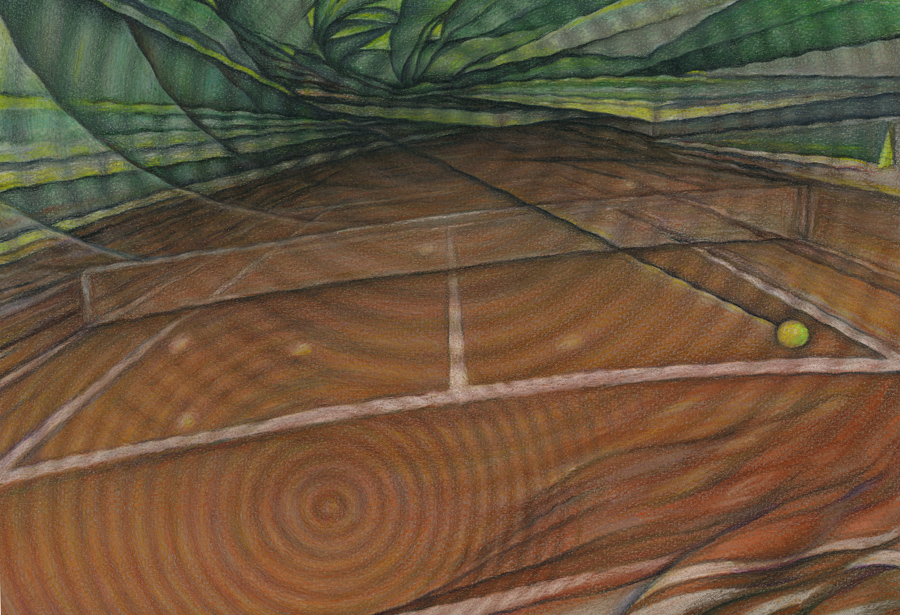
In tennis a "winner" is a shot the opponent can't hit. It's an action, not a person. Enjoy lots of them in the French Open finals this weekend. Serena Williams has been magnificent and plays last year's champion, Maria Sharapova. Rafael Nadal plays David Ferrer on Sunday. Both are at 9AM.

Sports Perspective

The idea of perspective is both literal as how things look from where
we stand, and a key metaphor for representing point-of-view. Every
different perspective enlarges our own and as we gain a broader
outlook we can see, not just from another’s point-of-view, but how all
the parts of the picture function together, the value of each entwined
with the whole. We each stand in a particular place in time and space
and understand better than anyone else what it’s like within that
group of relationships. It’s an understanding of a set of patterns
that can be recognized in different circumstances.  Our view will
match some circumstances and not others. Warring views are a waste of
energy that would be better spent matching and integrating so that the
multiple views and relationships between them become the broader
perspective of big picture thinking. This is why the hierarchical
models that dominate so much of life have done so much harm. It’s
often more about power, what view takes charge, and not about what
would be best for a circumstance. It’s where competition interferes
with perspective.

In sports, competition is what can bring out the best in an athlete.
Every member of a team has their own role and attendant perspective.
Each trusts the other players to be guided by theirs. Players make
their own decisions in the realm in which they’ve trained. Even in
opposition there is the straightforward acknowledgment of the other’s
goal. There’s respect for the worthy opponent. Watching the first
round tennis in the French Open, Venus Williams against Urzsula
Radwanska demonstrated in dramatic fashion the paramount advantage of
competition. Each can push the other to heights not achievable in
isolation. By the end Venus had figured out exactly what was beyond
reach and put it there consistently, yet Urzsula was able to come back
with outstanding shots of her own leaving me cheering and smiling. I
wanted them both to win. Flush with all the endorphins and dopamine I
realized that competition goes off the rails when its focus is solely
on winning and not on the opportunity to achieve new heights, discover
capabilities never before glimpsed and be in life to the fullest.
Though Venus lost, my respect for her was the highest it’s been since
her time as an early champion, her play was so precise and beautiful
to watch. With an opponent ready to capitalize on any failure of
concentration, the long rallies for a single point permit no lapses,
requiring the focus of a yogi. Watching kept me in the moment too,
staying with the point sharpened my own power of attention.

This is quite different from a culture led by dominant opinions that
ignore or exploit large groups of people as though it’s the right of a
particular perspective, distorting the picture everyone has to live
with. Where once there was an art to debate that enabled more about an
issue to come out and inform the whole, now it’s become a battle of
obfuscation, denunciation and rigidity that doesn’t come close to
including the true range of ideas on a subject. When research says
small schools work better, why the increasing trend to consolidating
and industrializing schools. Obviously there are motives that aren’t
about teaching. When research says fitness programs do more for
overall scores than sports, why are school physical education programs
still focused on sports which often put too much emphasis on winning
not excellence. Horror stories of coaches who are abusive to players
have little to do with excellence. It’s been a long time since I heard
someone say, “It doesn’t matter if you win or lose, it’s how you play
the game.” Reflecting the days when playing sports was about building
character, the goal to win just a means to personal excellence. She
might have lost, but for me the meaning of that match was Venus
Williams and what it means to be a champion.

Thursday, May 30, 2013

Song


Hybrid Vigor- Diversity in the Age of the Brain

I heard a radio story recently about the increase in biracial marriage
and found it gave me hope for our evolutionary possibilities as a
species. Biology has recognized for years the value of a more diverse
gene pool. Agriculture made a point of crossing different types to get
the best of each. Breaking down artificial boundaries between people
makes better use of the human genetic heritage without technological
intervention. The latter actually reduces the viability of the species
by selecting genetic traits based on a single group’s values. Just
like a uniform crop can be wiped out by a single disease, homogenizing
any species makes it more vulnerable. Nature moves toward greater
diversification. A broader gene pool offers new potential. In the
realm of ideas, a broader meme pool allows us to think more
comprehensively, avoiding the blocks to wisdom that come from
protecting rigid mindsets. Making multiple perspectives available
better shows the complexities of an issue and is the only way a true
resolution can be seen.

In regard to the tendency to stick to others like ourselves, I often
hear that it is just the way we are. Accepting the instinct is
accepting a boundary. I ‘m reminded of a famous experiment called the
Visual Cliff that demonstrated an inherited response. Originally
created by Eleanor Gibson with her own baby using a checkered
tablecloth over a table hanging to the floor, she then put a piece of
clear firm plastic over the empty space between the baby and herself
and called to him, discovering that he wouldn’t cross. This experiment
was repeated many times with painted checkerboard patterns and babies
of many different species, using food as an enticement. None would
cross the cliff. One of the researchers actually painted a trompe
l’oeil version on the nursery floor when they were expecting. Sure
enough, even though it was just paint and the baby could feel solid
floor the baby would not crawl across what appeared to be a cliff.
Adults walk across without fear, clearly illustrating the power of
learning for transcending instinctive response. It shows us that we
can overcome instinct with knowledge, an idea with far reaching
implications. This is the message of books like The Evolving Self, by
Mihalyi Czsentmihali and Beyond Conflict, by Peter Breggin. We have
certain survival instincts built in that can be transcended. As we
develop awareness in relation to automatic patterns we can change
them, freeing ourselves from unconscious responses, and giving
ourselves more choices in our actions. Freeing ourselves of genetic,
biological and life story conditioning is a task necessary for
anyone’s growth and emotional liberation.
Protective patterns limit the range of experience because they block
us from the new. They begin with instinctive vigilance toward the
unknown that can be recognized and stepped over, thus strengthening
the pre-frontal cortex, which directs conscious attention. Instead of
fortifying low-level brainstem reflex, we can choose to cultivate the
most evolved part of the brain and gain power over conscious
attention. The reward system reinforces pleasure in what’s new because
that’s what learning needs. As Gregory Bateson so succinctly put it,
“Information is the difference the makes a difference.” Only if it
something we don’t expect alters or adds to our understanding does
information count. Cultivating a taste for difference will help us
over superficial boundaries to the universal humanity that could grow
and evolve with the intermingling of ideas and groups that will enrich
the species. The premise that any one particular way of seeing and
being is right for everyone can finally wither and the strengths of
the many can intermingle to the benefit of all.

Wednesday, May 15, 2013

Stretch


Un-Classification- The Circle of Humanity


Recently a CNN news bite at the bottom of the screen said “Republicans say the bombing (Boston) came from the Muslim community” suggesting “they” need more scrutiny. Millions of people that live normal day-to-day lives side by side with everybody else are grouped for suspicion because of two deranged individuals. This seems like such a primitive fear response. Perhaps it is the left hemisphere verbal analytical classification that we use for so much conditions people to stick with their own groups, to limit ideas to what’s already believed and see only what supports their existing worldview. Perhaps it’s the conditioning in right or wrong answers that designates different as having to be wrong. Either reflects a highly limiting mindset. a rigid skin that needs to be shed. The human reward system is designed to encourage behavior that extends our boundaries, that embraces novelty. We wouldn’t get that extra dopamine from what’s new if it wasn’t good for us. Our brains are designed to reward what we should do more of, which includes stimulating curiosity about what’s unknown to us. This interest in the new is the action of learning rewarding us with endorphins to encourage continued growth. The cycle of seeing the new, becoming interested, then learning, is the action of the brain’s development, of feeling alive in the world while finding out what is possible.

The desire to tame the dangers of the world with labels and laws creates more separation between people. It creates an attitude of suspicion and mistrust that makes it hard to fully invest ourselves in participating, cooperating and appreciating. When you look at pictures of the earth from space there are no divisions, no national boundaries or political/religious states. We are a single species on a single world and its time to grow out of species adolescence and its cliquishness into a mature humanity, not so easily threatened by the unfamiliar, not so sure of our own right answers. The beauty of thinking in images and looking at them is that images are fluid, the whole seen at once, everything in relationship, rich with action and function and qualities that categories leave out. Thinking too much in categories misses the fullness. Ultimately we can’t even see the depth in ourselves, hidden beneath all the classifications, boxes we check on the forms.

Peter Breggin, a psychiatrist who speaks out against the practice of drugging people into the acceptable categories, wrote in his book “Beyond Conflict”, “Wisdom grows with the size of the group with which you identify.” The right hemisphere of the brain sees the whole, the more perspective that’s included the more accurate the whole. More time with imagery and less with words might help us break out of the shell of fear created by the cultural obsession with enemies and “Bad guys”, as adolescent a terminology as I can imagine that stirs the very few dangerously unstable among millions of peaceful people to dramatic acts of violence that can be more fuel for the media fires. The act of classification obscures the individual and substitutes the existing association with the categories contaminated by whatever media permeates the day. It blinds the classifier not only to people who could teach us something but also to personal dimensions not acknowledged by their own category. We are all the human species embedded in the world of living things. Some use their category to claim more than their share or the absolute right of their ideas for all. Brain science shows how thin those claims are. Each life strategy grew from what it had to experience. It involved knowledge and skills for a particular way of coping. What the authorities say may not fit the circumstance. From the beginning of life, for better or worse, we learn by example. Self-improvement is emulating who we admire, not what somebody says.